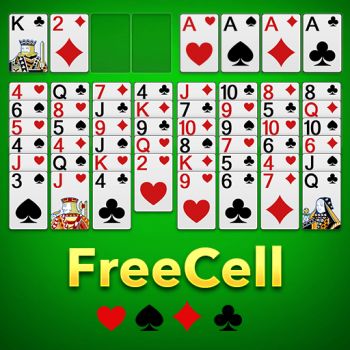
Overview of Freecell
Freecell is a classic solitaire card game that has been enjoyed by millions of players around the world. Unlike many other solitaire variants the game does not rely on random shuffling to create an impossible layout. All cards are dealt face up at the start of the match which means that every game can be solved with careful planning and logical thinking. The game uses a standard deck of fifty two playing cards and offers a clean and simple interface that is perfect for quick sessions or long strategic sessions.
How to Play Freecell
The objective of Freecell is to move all fifty two cards to four foundation piles. Each foundation pile is built in ascending order from ace to king and must be grouped by suit. The playing area consists of eight tableau columns where the cards are initially dealt. In addition there are four free cells that act as temporary storage for single cards. Players can move the top card of any tableau column to another column, to a free cell, or to a foundation pile. A card may be placed on another tableau card only if it is one rank lower and of opposite colour. The free cells provide flexibility because any card placed there can later be moved to a suitable location.
Because all cards are visible from the beginning, the game rewards forward thinking. A typical approach is to free up the ace cards as quickly as possible, then build the foundations while keeping at least one free cell open for maneuvering. When a tableau column becomes empty it can receive any card, which is a valuable tool for rearranging the layout.
Strategies for Success
Plan Your Moves Ahead
Before committing to a move consider the impact on the free cells and the empty tableau columns. A common mistake is to fill a free cell with a low value card that will later block a necessary transfer. Keeping at least one free cell open for most of the game gives you the ability to shift cards around without breaking the flow.
Prioritise Empty Columns
Creating an empty tableau column is one of the most powerful actions in Freecell. An empty column can receive any card, which allows you to relocate a sequence of cards and uncover hidden cards in other columns. Focus on clearing a column early in the game and use it as a staging area for larger moves.
Build Foundations Evenly
Do not concentrate all of your attention on a single suit. Building each foundation at a steady pace prevents a situation where one suit becomes blocked while the others are already complete. Balanced progress across all four suits keeps the game flexible.
Avoid Unnecessary Moves
Every move should have a purpose. Randomly shuffling cards between free cells and tableau columns can quickly lead to a dead end. Before moving a card ask yourself whether the move brings a new card into view or creates an empty column.
Replay Value and Community
Freecell offers virtually unlimited replay value because each shuffle creates a new challenge. The game is known for its high win rate among solitaire enthusiasts, yet the difficulty can be adjusted by selecting different starting layouts. Many online platforms provide a ranking system that tracks the number of games solved, the time taken, and the number of moves used. This creates a competitive environment for players who enjoy improving their efficiency.
Because the rules are simple and the interface is clean, Freecell is a popular choice for both casual players and serious strategists. Online forums and discussion groups often share advanced techniques, such as optimal sequences for clearing columns or methods for solving the most difficult layouts. Engaging with these communities can help new players develop a deeper understanding of the game and discover new ways to challenge themselves.
Frequently Asked Questions
Is Freecell a game of luck or skill?
Freecell is primarily a game of skill. Since all cards are visible from the start, success depends on logical planning and strategic use of the free cells and empty columns.
How many free cells are available in a standard game?
A standard game provides four free cells. Each cell can hold only one card at a time, and the cards stored there can be moved to any suitable location when needed.
Can I solve every Freecell layout?
Most layouts are solvable with the right approach. However there are a few rare configurations that are mathematically impossible to complete.
What is the best way to improve my win rate?
Focus on keeping at least one free cell open, create empty columns early, and build the foundations evenly. Practising these habits will lead to a higher success rate.
Is there a time limit for each game?
Freecell does not impose a time limit. Players can take as much time as they need to think through each move, which makes it an ideal game for both quick breaks and extended sessions.